It’s been a while since my last post. I’ve had a productive couple of weeks though, poetry-wise: poetry events including workshops and poetry slams, submitting poems to journals (and getting accepted!), and writing poems for submission have all been keeping me busy.
This last week, I’ve been trying, specifically, to write a poem about ‘belonging.’ One of my #goals literary journals is currently open for submissions with this theme, and I’ve been questioning what the idea of belonging really means to me. In previous posts, I’ve talked about aspects of my identity that make me struggle to feel like I belong. So thinking about belonging inevitably means thinking about not-belonging. Something that comes to the forefront of my mind with this is the weighted question “where are you from?” that is often directed at people of colour in (majority-white) Western countries.
I love this poem by Ally Ang, published in the Shade Journal, addressing this question –
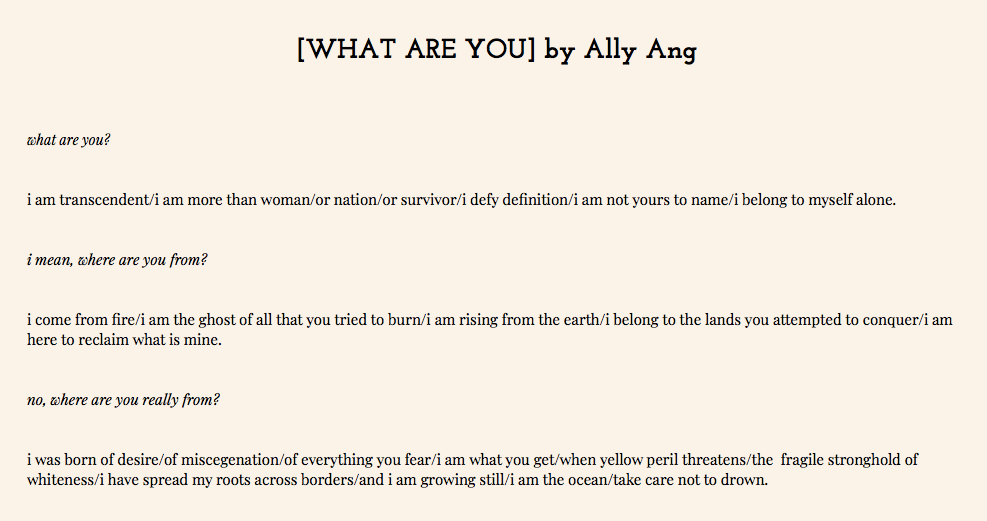
The poem is subversive in its response to that persistent question, to the asker’s apparent need to ‘know,’ presumably in order to put the poem’s speaker into a box. I love this poem because I understand the place it comes from (pun not intended). I often feel uncomfortable whenever a (white) person I don’t know asks me where I’m from. This discomfort comes partly from the complexity of the answer, but there is more to it that, for a long time, I couldn’t name – this question, when coming from a white person, always feels like it is seeking to Other me, to put me in a box based on a watered-down answer that I feel compelled to give. The question carries connotations about my origins and where I belong. However, when coming from another person of colour, the question feels more like kinship, the acknowledgment of shared experiences and in some cases, a desire to make a deeper connection based on similar or shared origins.
The thing about the question “where are you from?” is that it demands a specific type of answer – that of a place, a country or a city. As such, it seeks to erase the person’s other complexities and identities, reducing them to a place of origin. This, in itself, is problematic, due to the constructive nature of borders and therefore of countries and nationalities. In the above poem, the speaker defies this demand, instead claiming a multitudinous identity that goes beyond artificial constructs, one that physically cannot contain borders: “i am the ocean/take care not to drown.”
Based on personal experience, the feeling of belonging or not-belonging often comes down to circumstance. Where I am and who I’m surrounded by are some of the things that inform my sense of belonging at any time. The question of how I define my identity within the confines of country and nationality also, I believe, comes into play. These are ideas that I would like to explore some more in the future, perhaps after I’ve managed to write that poem. In the meantime, you can check out my poem “Origin Story,” in which I grapple with the very question I’ve explored in this post.
 KAYA ORTIZ
Leave a comment