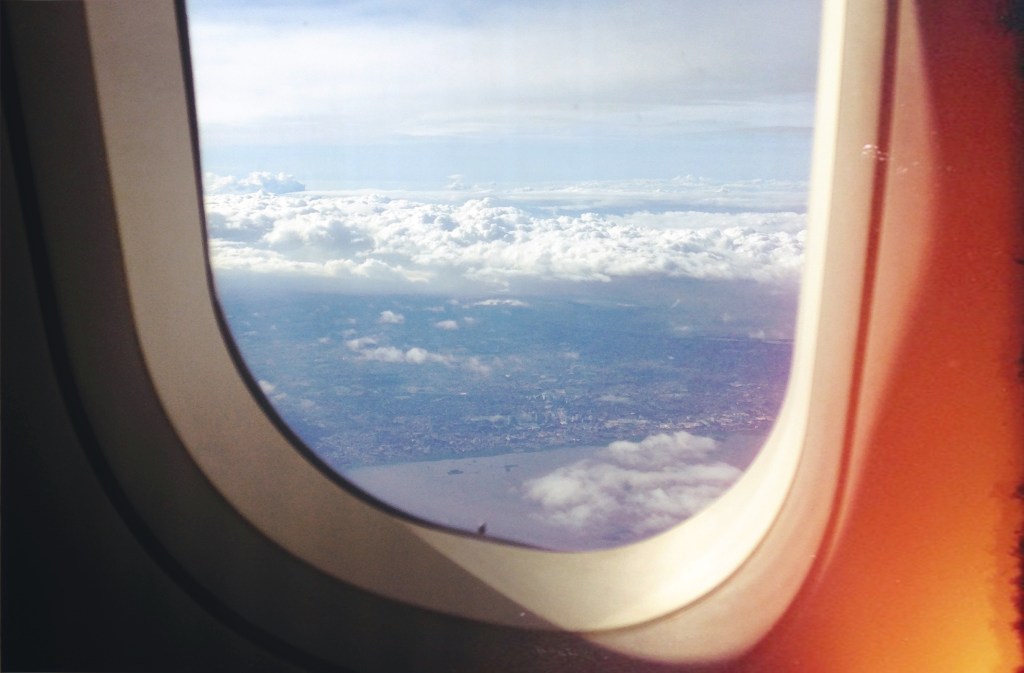
In my last post, I talked a little about my experience as a person of mixed race/ethnicity. I mentioned how, because of this, in both of my countries of origin, I am perceived as an immigrant. Although in many ways I felt that word did not apply to me because neither of the countries in which I have lived have been ‘foreign’ to me, I have since come to identify with it.
The other week, I came across the term ‘migration trauma’ while scrolling through my Twitter feed. Despite having never heard it before, I was immediately struck by it. Even before attempting to find a definition, I knew that this concept totally described my experience during and after my family’s migration from the Philippines to Australia.
Have a read of this brilliant poem about migration, Return by Gala Mukomolova. I’ve included the latter half of the poem here:
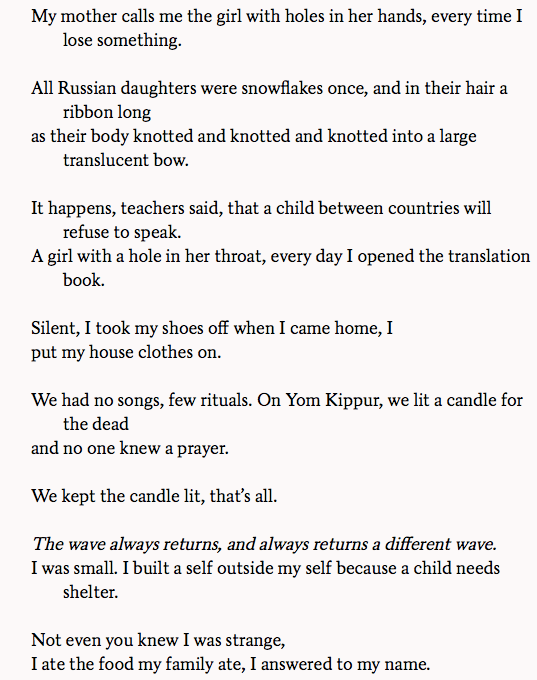
I feel that this poem really captures the kind of trauma that comes with migration, especially from the perspective of a child or teenager, as I was when my family moved. The final two lines are especially poignant for me – they evoke a person who, having lost everything that was once familiar, becomes a stranger even to themselves.
These days, when I recall my childhood, my friends, my schooldays in the Philippines, I am always struck first and foremost by how distant those memories appear now, how they are a lifetime away and I am a completely different person. I’m sure this is not an uncommon experience for those of us who have reached adulthood, but I cannot help but feel that it is, in part, exacerbated by the vast difference of the place of my childhood to the place where I live now.
The thing about change is, often in life, it occurs in such slow, minute doses that you barely notice until one day, you look back and everything is different. Moving across countries is a rather sudden uprooting in comparison. And despite the many advantages to moving to Australia, despite the high quality of life, the experiences I’ve had, the people I’ve met, the person I’ve become – none of which I would ever take back or change, even if I could – in spite of all this, migration is painful.
Seven years on, I still remember that first year well. Like the girl in the poem above, I felt I had been rendered a stranger. Over the years, as I’ve grown accustomed to this life, I’ve had to come to terms with a lot of things, like my ethnic and racial identity as I mentioned in my previous post. I am still constantly learning things about myself, my identity and my experience, many of which tie into this key moment in my life.
My family’s migration was pivotal – it couldn’t not be. I view much of my life as occurring in a Before and After-style montage: Before migration, After migration. Point A and Point B. Sometimes, I still feel as though I am caught in the middle, forever halfway through an international flight, hovering high above the endless Pacific, seeing nothing but blue all around. Other times, I am grounded yet dissonant, seemingly unable to find what I am searching for, too often unsure of what that is. But I am learning to be okay with this.
A couple years ago, I got back into writing poetry again. I found myself writing poem after poem about home, displacement, migration, goodbyes. Even now, I am still, to quote an old poem of mine, “writing poems / about the weight of saying goodbye.” This is how I have learned to process pain and trauma. This is how I hold on, and let go. This is how I remind myself of everything that has preceded who I am now, of every place, every memory, every feeling.
This is how I am learning to heal.
 KAYA ORTIZ
Leave a comment