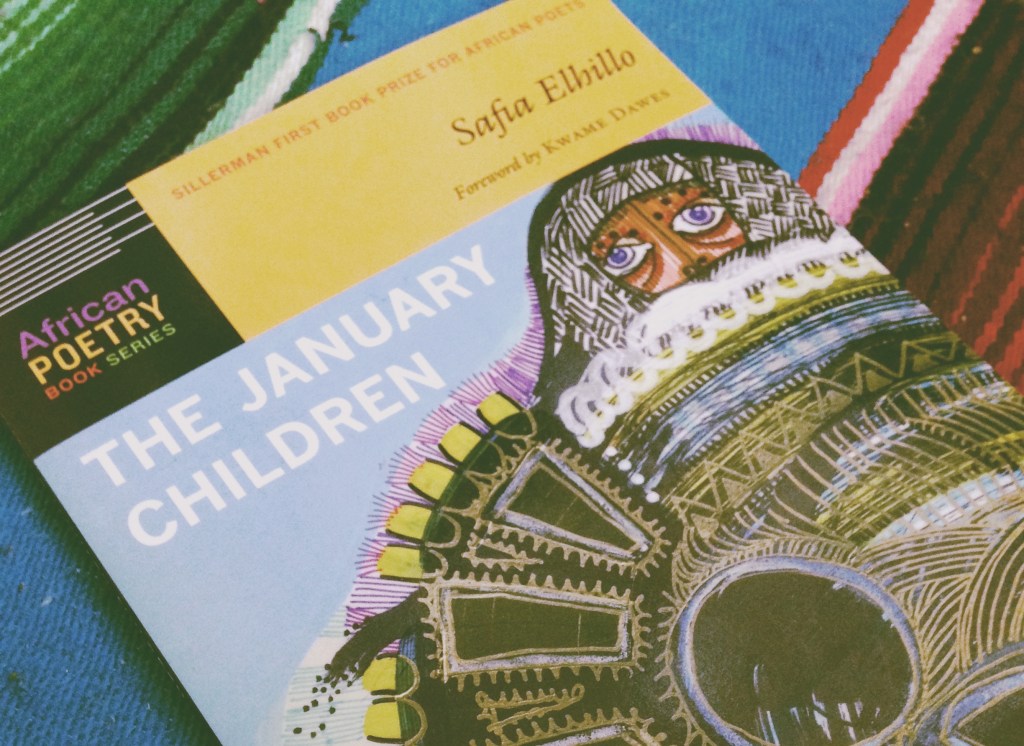
I thought I’d write my first post in honour of one of my favourite poets and poetry collections – Safia Elhillo’s The January Children. I first discovered Safia Elhillo through a 16-minute long YouTube video of a reading she had done that consisted of a suite of poems. Immediately, I knew I needed more, and I’m here to tell you why.
Safia Elhillo is a Sudanese-American poet and a person of the African diaspora. In her full-length poetry collection, she writes about displacement and diaspora, racial and ethnic identity, language and family, story and history.
Here’s a line from my favourite poem in the collection.
“for every country i lose i make another & i make another” – self-portrait as a map
As someone who identifies as both a person of mixed ethnic and cultural heritage and as an immigrant, this book’s themes really resonate with me. Since I’ve started seriously writing poetry, I’ve found immense value in reading a wide range of poets. But the poems and poets that stay with me are always those that speak to my personal experience. While this is a big part of why I adore Elhillo’s poems, another part of it is her distinct writing style and use of language.
On the page, Elhillo’s poetry has a distinct visual effect, employing spaces in lieu of punctuation. As an example, here is what “self-portrait as a map” looks like (photo taken from my copy of the book; I love this poem unapologetically).
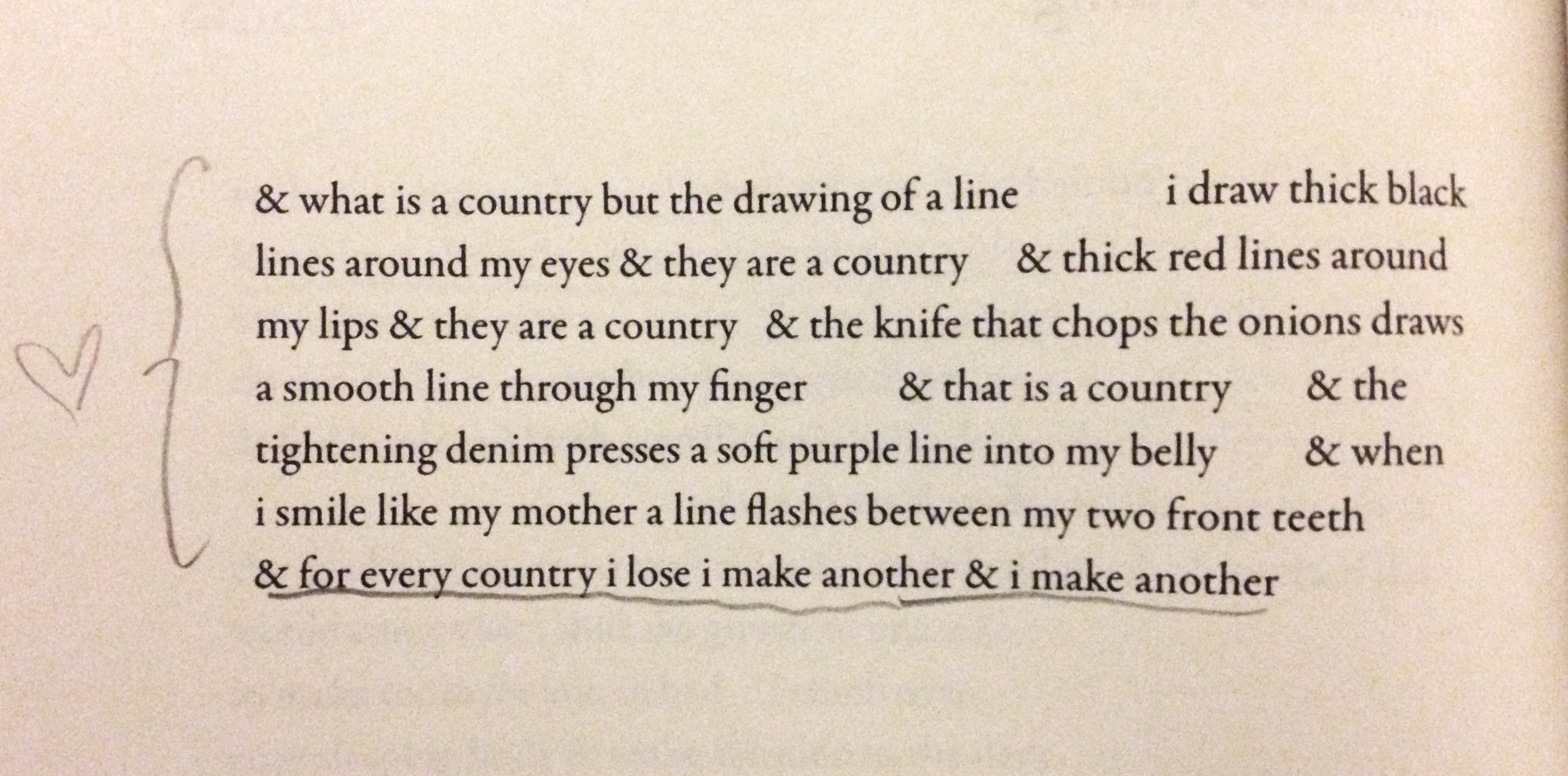
Like all good writing, Elhillo’s poems are also evocative, conjuring images that leave a lasting impression. I especially love how the whole poem, in this instance, functions as a metaphor for the way we, as humans, create identities in relation to space and place. Whenever I read her poetry, I am always struck by the unique perspective that allows her to craft language, imagery and metaphor so powerfully. I find her poetry is at once easily accessible, yet multi-layered and complex.
When I read Elhillo’s poetry, it cuts to the deepest part of me. I don’t how I can explain it to you, unless you’ve felt the same way once, but I’ll try. Often, when I was a child, and later also as a teen, my deepest desire was to be fully known and understood. Somehow, I have found something of this understanding in Elhillo’s poems. It is like seeing a clear reflection of my soul in a mirror, when before everything was murky and dark.
As you can see, I truly adore Elhillo’s poetry. In the future, I am planning on creating posts that center around a specific poem (both Elhillo’s and other poets’), a sort of close-reading, if you will. But for now, I leave you with this – if you enjoy reading poetry, or even if you don’t; if you identify with any of the themes I mentioned before, I highly recommend Safia Elhillo’s poems.
Here are some links and excerpts to some of her poems if you’d like to see more:
“& isn’t a map only a joke we all agreed into a fact”
“& what even is translation is immigration without
irony”
“i come from two failed countries
& i give them back”
“we begin because the worlds before ours ended”
“how did you learn fear?
i crossed a body of water”
“black that holds up against language and sea
black the only name assigned my body”
 KAYA ORTIZ
Leave a comment